TL;DR / Key Takeaways
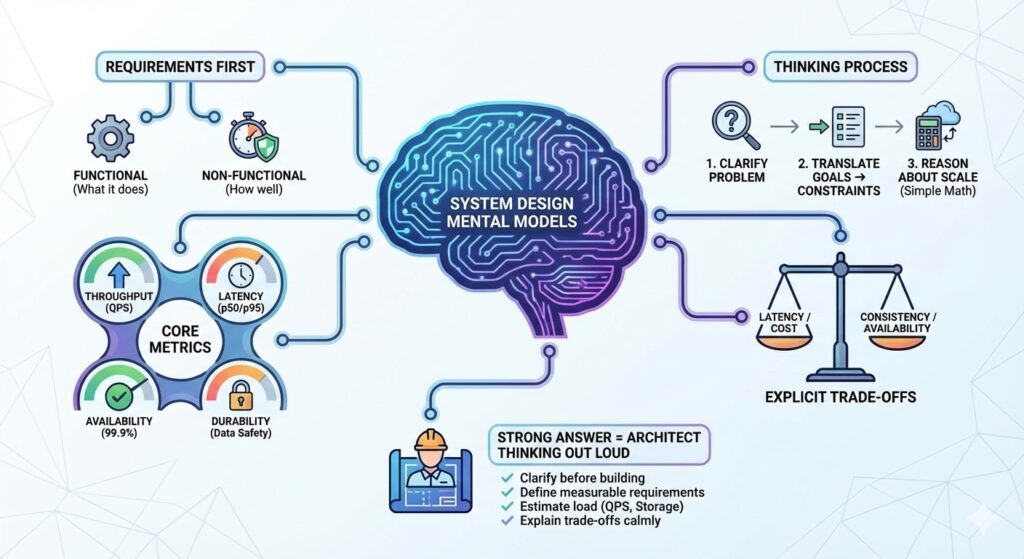
- Interviews test your thinking process more than a perfect architecture.
- Start with requirements, then quantify load and constraints.
- Define the core metrics: throughput, latency, availability, durability.
- A good design is a series of explicit trade-offs, not a single right answer.
What System Design Interviews Actually Test
Most interviews are not asking for the most complex system. They are asking whether you can:
- Clarify the problem before building a solution.
- Translate vague goals into measurable requirements.
- Reason about scale using simple math.
- Explain trade-offs calmly and clearly.
A strong answer looks like an architect thinking out loud, not a checklist of technologies.
Requirements First: Functional and Non-Functional
Functional requirements define what the system must do. Non-functional requirements define how well it must do it.
graph TD
  R[Requirements] --> F[Functional]
  R --> N[Non-Functional]
  N --> S[Scalability]
  N --> A[Availability]
  N --> L[Latency]
  N --> C[Cost]
Ask questions early:
- Who uses it, and how often?
- What is the read vs write mix?
- What is the acceptable latency and error rate?
- What happens when a dependency fails?
The Four Core Metrics
Use these terms precisely:
- Throughput: requests per second or transactions per second.
- Latency: time for a single request, usually p50 and p95.
- Availability: percentage of time the system is usable (for example 99.9%).
- Durability: probability that committed data is not lost.
A design that optimizes one metric often harms another. That is the point.
Translate Requirements into Constraints
Turn vague goals into hard constraints you can design against:
- Read vs write mix drives caching, storage choice, and scaling direction.
- Consistency expectations drive data model and replication strategy.
- Data retention and growth define storage and backup needs.
- Latency targets define how much work each hop can do.
Write these constraints down early so you can defend trade-offs later.
Latency Budgets and Critical Paths
If the user target is p95 = 200 ms, split that budget across components. Example:
- 30 ms network and TLS
- 20 ms load balancer and routing
- 50 ms service logic
- 80 ms database or cache
- 20 ms for safety margin
Any single dependency that routinely exceeds its budget will break the latency target.
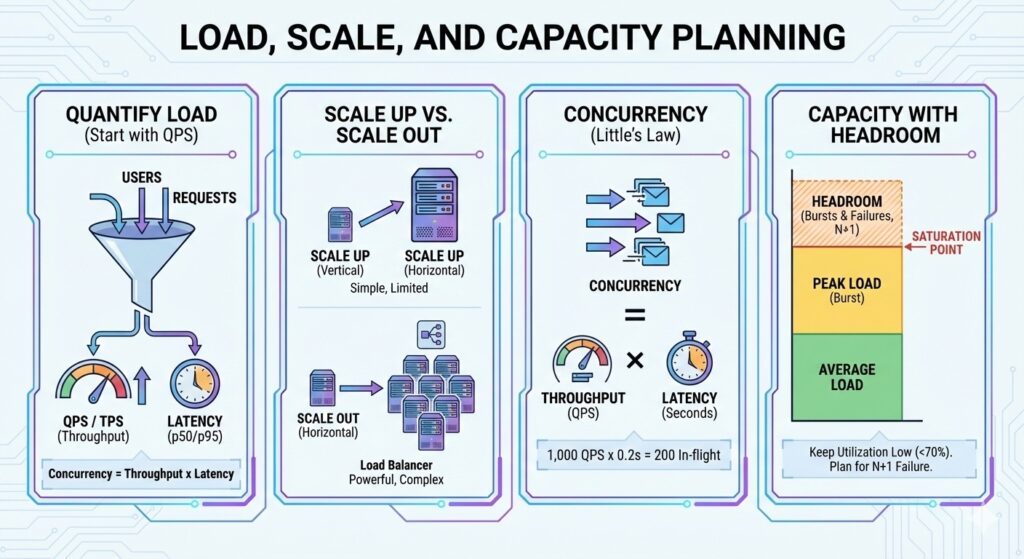
Back-of-the-Envelope Sizing
Quick math sets the scale before you design.
Example:
- 10 million daily active users
- 5 actions per day each
- 50 million actions per day
- 50,000,000 / 86,400 seconds = about 580 QPS average
Now add realistic peaks and storage:
- Peak factor 5x -> 2,900 QPS peak
- 1 KB per action -> 50 GB written per day
- 30 days retention -> 1.5 TB raw data (before replication)
You now know the system must handle a few thousand QPS peak and multi-terabyte storage.
Worked Example: From Requirements to Size
Assume 2,000,000 daily active users and 4 actions per day:
- Actions per day = 2,000,000 * 4 = 8,000,000
- Average QPS = 8,000,000 / 86,400 = about 93
- Peak factor 5x -> about 465 QPS
- Read/write split 90/10 -> about 420 reads/s and 47 writes/s
- Each write is 2 KB -> about 16 GB/day (8,000,000 * 2 KB)
- 30-day retention -> about 480 GB raw
- 3x replication -> about 1.4 TB total
The Assumptions Ledger
Keep a short list of assumptions you are willing to defend:
- Peak factor and traffic distribution (steady vs spiky).
- Read/write ratio and request fan-out.
- Availability target and data loss tolerance.
If any assumption changes, explicitly describe how the architecture changes.
Common Failure Modes in Interviews
- Skipping requirements and jumping to architecture.
- Ignoring read vs write patterns.
- Not stating assumptions or estimating load.
- Treating latency, availability, and cost as free.
How to Narrate Trade-offs
A good structure:
- Clarify the use case and constraints.
- State assumptions and estimate load.
- Propose a simple baseline design.
- Identify bottlenecks and scale points.
- Offer alternatives with trade-offs.
This keeps the conversation grounded and shows senior-level thinking.
Checklist for a Strong Start
- Define the users and core user actions.
- Split functional from non-functional requirements.
- Estimate QPS, data size, and storage growth.
- Call out the key trade-offs you will make.
A clean mental model is the foundation for every system you design.